
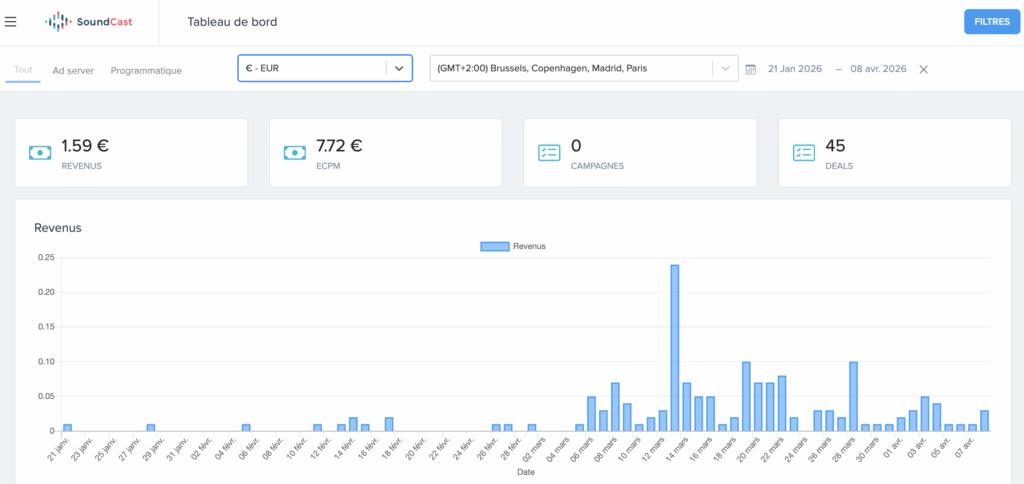
That’s it. We’ve finally earned our first Swiss Franc (CHF) from radio advertising thanks to the Soundcast.io solution, which we’ve been trialling on our two stations, UZIC (for electronic music) and Podkast.FM (for spoken-word podcasts) since the beginning of the year. Here the proof in figures:
When I think of all the back-and-forth we’ve had over advertising funding, it’s with a sense of emotion that I write these lines.
What on earth made us change our minds? Time has done its work ; practices in the field of radio advertising have changed significantly in recent years… and since we’re betting that subscription/community funding has little future, we might as well put our faith in independent, intelligent and socially conscious advertising!
Independent advertising ?
Without anyone really caring, there has been a shift in content publishing: social media platforms have seen fit to both publish content AND sell it. Until the early 2000s, content publishing* was driven by ‘mass’ media: newspapers, radio, television and the like were responsible for finding content creators – primarily journalists, but not only – selecting the right stories, deciding how they should be covered, structuring the content, producing it and finally distributing it. All of this used to cost, and still costs, a great deal of money in terms of salaries, production setup and to broadcast it.
Rather than continuing to invest in the sales department responsible for selling radio advertising, advertising agencies began to establish themselves as external companies to the media as early as the 1970s in Europe. Whilst this editorial/sales partnership could sometimes lead to friction, it had the advantage of clearly separating editorial interests from financial interests: the decision-makers were not the same people.
Today, we are faced with web platforms that want to do everything without actually taking responsibility for it: publishing content without taking responsibility for its editorial content AND running media advertising whilst setting the rules of the game on their own. So much for journalistic ethics; hello to the opinions of amateurs who are as ill-prepared as they are uninformative. This marks the rise of ‘clickbait’, which lures users in for the sake of advertising, distorts content to generate more of it, and indiscriminately sucks up vast amounts of personal and contextual data. As the ones left holding the bag (right after the public), most content creators remain underpaid.
What does the Odiolab association recommend instead ?
- Advertising managed by an external partner whose job is to do it, and do it well. Operating in France, the UK and the US, Soundcast and others are able to generate revenue beyond national borders.
- A radio advert that pays content creators. Let’s acknowledge that they do a large part of the work and, without creators, there would be no advertising. We explain how this works in the ‘Conscious Advertising’ section below.
- Clearly identified advertising: no mixing of genres; content and adverts each have their own dedicated space. On UZIC and Podkast.FM, we’ve decided to broadcast radio adverts as ‘stream launch’ adverts, i.e. during the first 15 to 30 seconds after the stream starts. It might seem a bit of a nuisance, but you know what to expect at least, and the advert then gives way entirely to the content.
Smart advertising ?
Unlike terrestrial radio, digital technology makes it possible to ‘track’ users’ every move. This may still seem a long way from artificial intelligence, but here is a practical example: a solution such as Souncast geolocates web listeners via their IP address. It becomes possible to target audiences living in France, the UK or the US with advertisers whose offerings meet local needs.
Thus, while the content broadcast is nationwide, the radio adverts are funded by local organisations, which have an interest in raising their profile within a specific area and tailor their advertising message accordingly.
Conscious advertising ?
We’ve saved the best for last! At Odiolab, we want to make advertising an ethical tool for collaborating with ‘our’ content creators. In practice, these are often artists working part-time or freelance consultants. It is through the ‘three-thirds’ principle that the Odiolab association aims to bring together artists and podcasters around a cultural platform combining music, dialogue and encounters to spark inspiration.
The three-thirds principle
Its aim is to compensate for the three key aspects of a radio organization such as UZIC or Podkast.FM:
- The first third of our advertising revenue goes to the artists and podcasters with whom the Odiolab association collaborates. They are our content creators. For UZIC, these are the independent DJs and music producers who send us the audio files they have created. For Podkast.FM, we are referring to partner podcasters who have agreed to broadcast each new episode on the radio, or to podcasts created by members of our association. Here, the focus is on the production effort, as the artistic quality cannot be judged until it has been tested by the public. From 1 April 2026, a breakdown of advertising revenue will be provided at the end of each quarter for each radio station. The advertising revenue statement will be compared with the schedule broadcast on each radio station, with content creators receiving a share of the revenue proportional to the airtime allocated to them.
- The second third of advertising revenue goes to the radio station creating the programme, broadcasting it and paying the copyright fees required to legally broadcast the content. After the artists and podcasters, we would like to thank those who manage the media operations themselves. This self-funding should also enable us to be more independent when organising events, providing us new opportunities for live content.
- The final third goes to those who make our two cultural media outlets a success, through digital or on-site promotion. Every week, our radio programmes are analysed, summarised, illustrated and shared by a handful of promoters and fans as quickly and effectively as possible. Generating listeners with a single click is an art in itself, and one that deserves to be rewarded. In this case, it is the outcome of the communication that counts, namely the reach achieved by each post on a social media platform. At first glance, TikTok, Instagram and YouTube are the three most effective digital platforms for the Odiolab association, ahead of Facebook, Meetup, Twitter and Thread.
Soon, artists on UZIC Radio and podcasters on Podkast.FM will be able to promote their own content – yet another reason to make a living from your art! Watch this space in our newsletter.
What next ?
These changes will lead to others, such as
- For our listeners: the option of an ad-free radio stream, in exchange for a voluntary donation to your favourite station
- For artists and podcasters: the establishment of more residencies, enabling them to secure a regular radio slot and to stabilise their income
- For members of the Odiolab association: a new incentive to improve our two radio stations, both in terms of organising the weekly schedule and promoting the programme
- For everyone: new websites for our two radio stations and our association, but first we’ll need to save up!
In the near future, new themed radio stations will be added to the audio content offered by the Odiolab association. It’s quite a programme – we did warn you.
* A definition of ‘content publishing’ according to the French Ministry of Culture: content publishing | FranceTerme | Culture